
AI Education Assistant
An AI tutor for Athabasca University, built on IBM Watson in 2019, three years before ChatGPT.
It starts with course material
In 2019 I directed the design and full-stack build of a pilot AI tutor for Athabasca University, made at Queen’s University’s Centre for Advanced Computing with IBM. That was three years before ChatGPT came out. Everything the tutor did started from a course’s own material.
Pulling out the key ideas
A Python NLP engine reads the material, and Watson NLU, part of IBM Watson, analyzes the same text to pull out its metadata. Between them they pick out the key ideas on the page.
Ideas become quiz questions
The Content Generation service turns those ideas into quiz questions. It’s one of three Node.js microservices, each running in Docker containers on Kubernetes.
A student asks, and the tutor answers
When a student asks the tutor something, the Conversation Generation service works with Watson Assistant, which handles the chatbot’s conversation and its training, to reply the way a tutor would.
The whole system
Students and educators each get their own view in the React front end, and Nginx sits in front of it for security and caching. Behind it are the three microservices, with MongoDB as the central database. They call on the NLP engine and on Watson, with Watson Discovery handling and storing the data.
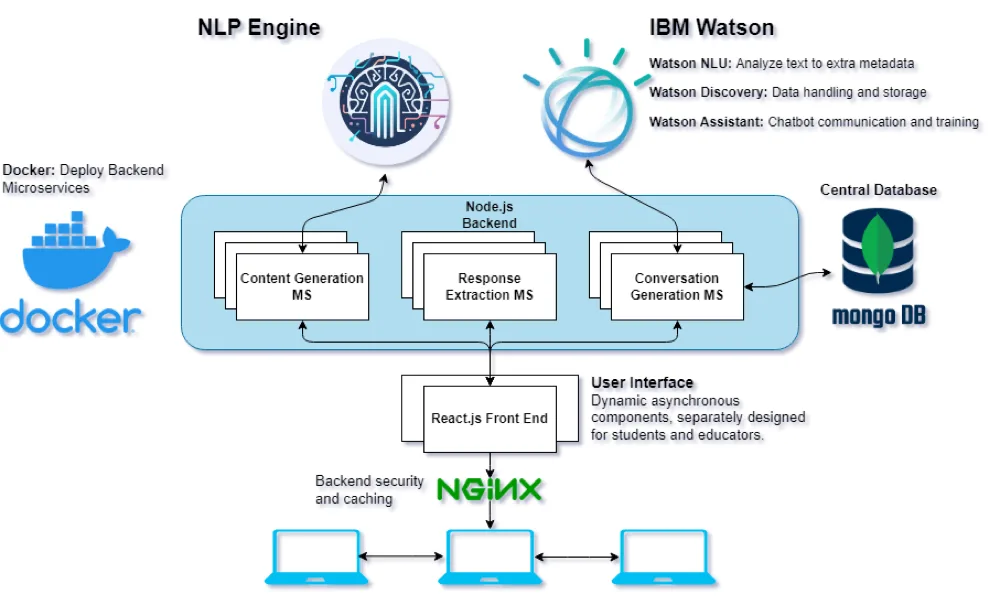
In 2019 I led the design and full-stack build of a pilot AI tutor at Queen’s Centre for Advanced Computing, working with IBM, for Athabasca University. It wrote quiz questions from course material and answered students’ questions, three years before ChatGPT made that ordinary.
Students and educators each had their own view in React. Behind it, three Node.js services in Docker on Kubernetes handled content generation, answer extraction and the tutor’s conversation, using a Python NLP engine and IBM Watson’s language understanding, search and assistant services, with MongoDB holding the course data.